.png)
The Complete Guide on
How to Become a Successful Notary Public & Loan Signing Agent

We'll Help You Put This All Together
Let's Start with the Difference Between Being a Notary Public and a Loan Signing Agent in
Cincinnati, Ohio
Understanding the difference between a Notary Public and a Loan Signing Agent (LSA) is essential when exploring a career in this field. While both roles are rooted in the authority of a state commission, their responsibilities, training, and earning potential vary. Recognizing these distinctions will help you make informed decisions about your notarial career path.

A Notary Public is commissioned by the state to serve the public as an impartial witness. Their core duties include:
-
verifying identities of signers through government-issued ID
-
witnessing signatures and ensuring the signer is willing and aware
-
administering oaths and affirmations for sworn statements
-
completing notarial certificates with their signature and official seal
The scope of a notary’s work is broad. General notarial acts include documents such as affidavits, contracts, powers of attorney, wills, medical directives, and business agreements. Because notaries are regulated by state law, each state sets its own rules on what documents can be notarized and how much can be charged per act.
A Loan Signing Agent (LSA, Signing Agent, Notary Signing Agent) is a commissioned notary who has additional training in mortgage loan documents and real estate transactions. Their work goes beyond basic notarizations to include:
-
presenting loan packages during real estate closings
-
ensuring every signature, initial, and date is properly completed
-
guiding signers through complex documents like deeds of trust, promissory notes, closing disclosures, and refinance agreements
-
returning executed documents quickly and accurately to lenders, escrow, or title companies
Although LSAs cannot provide legal or financial advice, their familiarity with loan packages makes them a vital link between the borrower and the lending institution.
Key Differences to Keep in Mind

Authority: Every Loan Signing Agent is a Notary Public first. You cannot become an LSA without first being commissioned as a notary.
Scope of Work: Notaries perform general notarial acts; LSAs focus specifically on loan and mortgage documents.
Clients: Notaries work with the general public, businesses, and government offices. LSAs primarily serve title companies, escrow officers, lenders, and signing services in the mortgage industry.
Why It Matters
Becoming a Notary Public is the first step. It provides the legal authority and credibility to perform notarizations.
Adding Loan Signing Agent specialization builds on that foundation, opening the door to higher-paying assignments in the real estate sector. For many notaries, this is where the career shifts from part-time side work to a profitable business.
Learn more from the National Notary Association: What is a Notary Signing Agent?
Let's Talk (Honestly) About How Much You Can Earn as a Notary Public & Loan Signing Agent in
Cincinnati, Ohio
When people search “How much can a notary make?” or “Is becoming a Loan Signing Agent worth it?” they often land on bold claims and flashy numbers on social media. The reality, however, is more nuanced—and it’s important to approach this career with accurate expectations.
Be Careful Who You Follow Online
Not everyone on social media gives the full story. To put things in perspective, here’s the truth:
-
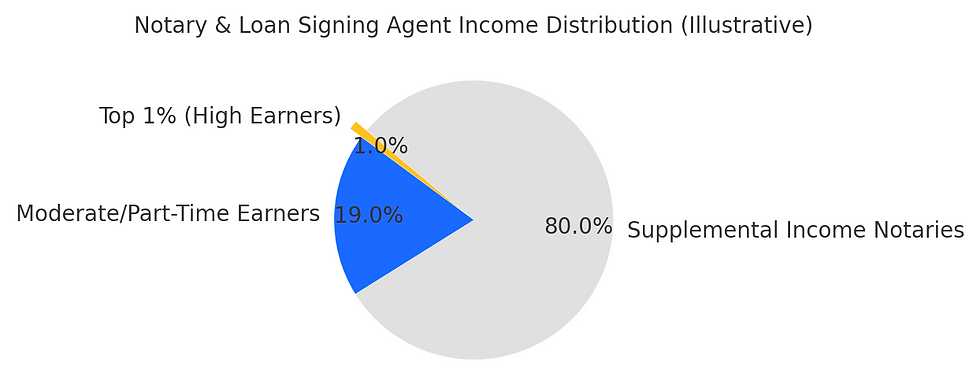
Only about 1% of notaries and loan signing agents reach “six-figure” or top-tier incomes.
-
The majority earn supplemental income, with a smaller portion building part-time or moderate full-time careers.
-
This breakdown is best seen in the income distribution chart: most fall into the “supplemental income” group, with very few reaching the top slice.
Meanwhile, the fee comparison bar chart makes it clear: loan signings simply offer more per assignment. That’s why many notaries branch into loan signings if they want to grow their earnings.
.png)
-
A Notary Public earns state-regulated fees, typically ranging from $5 to $15 per notarization depending on state law
-
A Loan Signing Agent, by contrast, negotiates per-assignment fees, often $50 to $200+ per signing, since real estate closings involve larger document packages and tighter deadlines
.png)
The good news? There are many ways to expand your income as a notary beyond standard notarizations and loan signings.
Successful notaries often diversify into niche services such as:
-
Jail and detention notarizations
-
Hospital and healthcare facility notarizations
-
Apostille facilitation
-
I-9 verifications
-
Permit running
-
Translation coordination
Each of these creates new revenue streams and sets you apart from other notaries in your area.
Where Real Opportunity Lies
Learn more from the National Notary Association: Notary Business Basics
Learn more from the National Notary Association: Notary Signing Agent Overview
Learn more from the National Notary Association: How Much Can Notaries Charge?
Learn more from Notary Stars:
How Notaries Can Market to Hospitals & Jails
Learn more from Notary Stars:
Additional Income for Notaries
Here Are the Basic Steps You Should Take to Become a Notary Public in
Cincinnati, Ohio

How to Become a Notary Public in Ohio
To become an Ohio Notary, you must complete the following steps:
Meet the state's requirements.
Get a criminal records check.
Take the required Notary training course and pass the exam.
Complete the application on the SOS website.
Receive your commission via email.
Buy your official Ohio Notary stamp.
Here Are More Details About Becoming a Notary Public in
Cincinnati, Ohio
How to Become a Notary Public in Ohio
To become an Ohio Notary, you must complete the following steps:
Meet the state's requirements.
Get a criminal records check.
Take the required Notary training course and pass the exam.
Complete the application on the SOS website.
Receive your commission via email.
Buy your official Ohio Notary stamp.
If you are seeking to become a Notary Loan Signing Agent in Washington it is strongly advised that you take additional training beyond the National Notary Association.
The National Notary Association helps to prepare Notaries on a very basic level. However, companies like Notary2Pro, NotaryStars, and NotaryAcademy are all very well poised to help Notary Loan Signing Agents learn the meaning of Loan Documents, How to Present Loan Documents, What You as a Notary Can Say About Loan Documents, and How to Execute Loan Documents. Ideally, the highest paid Loan Signing Agents will have taken all three of these courses and more.
Companies like Notary Stars can also help point you in the direction of additional reputable trainers within the industry who can also show you how to perform additional services like Permit Running, Apostille, Document Translations, Estate Planning, and more! These are additional sources of revenue that the National Notary Association does not cover.
About the Ohio Notary Process
An Ohio Notary commission lasts for five years. Learn more about the Notary Public application process in the Buckeye State.
Cost to Become an OH Notary
The cost to become an Ohio Notary Public is approximately $248. However, this cost may vary depending on where you purchase your Notary seal.
Commission Processing Time
The timing can vary based on the vendors you choose to work with. However, you have six months from receiving your criminal records check to complete all steps of the Notary application process. Once the six-month mark has passed, you’ll need to restart the application process from the beginning.
Ohio Notary Public Requirements
Read on below to learn what you need to do to become a Notary in Ohio.
Eligibility
To qualify for an Ohio commission, applicants must meet the following qualifications to become a Notary:
Be at least 18 years old
Be a resident of Ohio or a non-resident attorney who practices law in Ohio and whose principal place of business or practice is in Ohio
Not have any disqualifying offenses on your record
What is considered a disqualifying offense?
Generally, disqualifying offenses are crimes of moral turpitude, fraud, theft, sexual and other violent crimes. In Ohio, the specific offenses are defined in section 4776.10 and Chapter 2913 of the Revised Code. The Secretary of State's website also has an overview chart of disqualifying offenses.
It is up to the Secretary of State to use its discretion to determine if a particular offense disqualifies an applicant from a Notary commission.
Criminal Records Check
Get a criminal records check by visiting an authorized agent of the Bureau of Criminal Identification and Investigation (BCI). Make sure to request 147.022 as the reason code to ensure the proper search is conducted, and it also instructs the Webcheck® location to provide you with the report directly.
Submit this report with your Notary application within six months.
Please note: Peace officers are not required to obtain a criminal records check.
Notary Training
Applicants for an Ohio Notary Public commission are required to take a three-hour Notary training course from a state-approved education and testing provider.
Exam
After completing the Notary class, you'll need to take and pass an exam administered by the education provider you chose for the training.
If you don't pass on your first try, you'll have to wait 30 days to retake it. If you don’t pass the second time, you'll need to restart the application process from the beginning.
Attorneys applying to become an Ohio Notary do not need to pass an exam.
Application
Create an account on the Secretary of State's website to complete your Notary application. Upload a PDF copy of your criminal records check, your course and test certificates, and an image of your signature. Pay the $15 submission fee.
You’ll receive your commission certificate via email. The email will include instructions from the Secretary of State regarding your oath of office.
Notary Supplies
Once you have your Notary commission, you'll need to buy an official Notary seal, which can either be a stamp or an embosser. The seal must contain the following information:
The coat of arms of the state within a circle that is at least ¾" but not larger than 1" in diameter
The words "Notary Public," "Notarial Seal" or words to that effect
Your name (you could also print, type or stamp your name near your signature instead of displaying it on your seal)
The words "State of Ohio"
If you want to use an embosser, you'll also need an inker to make the impression of your seal visible when photocopied.
Which state government office handles Notaries?
The Secretary of State handles Notary commissions as well as remote online Notary authorizations.
Secretary of State
180 E. Broad Street
Columbus, OH 43215
The Notary Modernization Act transferred this responsibility from Ohio's 88 counties to the Ohio Secretary of State's Office, located in Columbus, OH.
Is a Notary journal required?
While using a Notary journal to keep track of your traditional notarizations is recommended by the state, it's not required by law.
Do I need a surety bond or insurance?
A surety bond is not required in Ohio.
Errors and omissions (E&O) insurance is optional. Notary E&O insurance helps protect you if you make an unintentional mistake or a false claim is filed against you. Your E&O policy will cover your legal fees and awarded damages up to the coverage amount you select.
Where will I be able to notarize?
Ohio Notaries can practice throughout the state.
Who can I notarize for?
You can notarize for any member of the public who makes a reasonable request and meets all requirements for notarization, such as personally appearing before you and providing satisfactory proof of identity.
You cannot notarize your own signature or perform a notarization if you have a conflict of interest.
How much can OH Notaries charge for their services?
Ohio Notaries may charge $5 per notarial act. A reasonable travel fee may be charged, but only if you and the signer agree to it in advance.
What should I do if I move or change my name?
You must inform the Ohio Secretary of State of any name or address changes within 30 days. Log into your account and follow the steps online.
For name changes, you'll need to upload a copy of your new signature that matches your new name and pay a $2 fee. Your commission will be emailed to you.
There is no fee for an address change.
How do I renew my Notary commission in Ohio?
The renewal process in Ohio is similar to the process of becoming a new Notary. The differences are that the education course is reduced to one hour, you aren't required to take another exam and it only costs $45.
You can renew your Ohio Notary commission three months prior to your current commission's expiration date.
What do I need to know about remote online notarization in Ohio?
Ohio Notaries with an active commission may qualify to perform remote online notarizations. Follow the steps in this guide to become an OH remote Notary.
Loan Signing Agent Training That Will Help You Start and Flourish in Your Career in
Cincinnati, Ohio
Once you are commissioned as a Notary Public, the next step for many professionals is pursuing additional training to become a Loan Signing Agent (LSA). Specialized education is what sets apart those who simply hold a commission from those who build a thriving notarial business.
Unlimited Ink Notary is proud to be a sister company to Notary Stars, a nationally recognized training platform that equips notaries with the knowledge and confidence to succeed. Alongside other trusted educators like Notary2Pro and My Notary Academy, these organizations provide structured, reputable paths into the loan signing industry.

Why Training Matters
While the fundamentals of being a Notary Public are state-specific, loan signing work requires an additional layer of expertise. Lenders, escrow officers, and title companies want to work with notaries who understand their documents, avoid costly mistakes, and represent their brand professionally. That’s where quality training becomes invaluable.
Here’s a glimpse at what these programs offer:
-
Notary Stars – Known for its comprehensive library of over 150+ hours of video training, live classes, and community support, Notary Stars teaches every major loan product, best practices for notarial work, and provides marketing strategies to help notaries grow. It’s not just a course—it’s an ongoing resource hub with mentorship opportunities.
-
Notary2Pro – Founded by industry veteran Carol Ray, Notary2Pro is respected for its hands-on, personalized training. Its “Elite” program bundles essential and advanced courses, plus reverse mortgage specialization, giving students a strong foundation and continuing edge in the market.
-
My Notary Academy – This training company offers structured, easy-to-follow modules designed to help new notaries understand the loan signing process step by step. Its focus on practical exercises and real-world application helps build confidence quickly for those new to the industry.


Meet the Instructors of Notary Stars & Connect with Them on Your Journey in
Cincinnati, Ohio
Unlimited Ink Notary is proud to be a sister company to Notary Stars, where experienced professionals don’t just teach—they mentor, share real-world insight, and guide you through the complexities of building a notary signing career.

RON Trainer & RON Expert
Amy is a multi-state commissioned notary and RON (Remote Online Notarization) expert.
At Notary Stars, she trains notaries in digital notarization, apostilles, and international document work—helping them expand their services and adapt to the evolving notarial landscape.

New Notary Liaison
Kirsten is a New Notary Liaison and instructor at Notary Stars, guiding notaries as they take their first steps in the profession.
Drawing from years of notarial, customer service, and teaching experience, she focuses on helping notaries master the basics while building confidence and long-term business strategies.

Lead Instructor
Beth brings more than 20 years of experience in Title, Escrow, and as a Notary Signing Agent.
At Notary Stars, she develops and teaches courses ranging from foundational signing practices to specialized topics like reverse mortgages, equipping notaries with advanced knowledge to excel in the field.

Founder of Notary Stars
Ronnie is the founder of Unlimited Ink Notary, Notary Stars, and Remote Online Notary Network, and has over 15 years of experience as a Notary Signing Agent.
He specializes in Notary Business Marketing, helping notaries build strong local reputations and professional online presence.
Through resources like his Notary Business Wix Template, he equips notaries to secure valuable digital real estate and stand out in competitive markets.

Bilingual (Spanish) Instructor
Manuel is a bilingual instructor who brings both expertise and inclusivity to Notary Stars training.
By teaching in English and Spanish, he ensures notaries serving diverse communities are equipped to handle signings with professionalism and cultural awareness.
Why This Matters
These aren’t anonymous voices behind a course—they’re your mentors. With decades of combined real-world experience, they equip you with not just the “what,” but also the “how”:
-
Learn how to avoid common signing mistakes.
-
Leverage niching strategies like reverse mortgages or online notarizations.
-
Get ongoing support, real examples, and up-to-date industry know-how.
Here Are Some Solid Suggestions of Supplies You'll Need as a Loan Signing Agent in
Cincinnati, Ohio
These are more than “nice-to-haves”—they are the backbone of efficiency and professionalism. Clients notice when documents are cleanly printed, neatly scanned, and properly documented. On the flip side, being unprepared with the wrong tools can cause errors, delays, and even loss of assignments. But supplies don’t end here. As you grow, you’ll discover specialized tools that can save you time, protect your liability, and enhance your notarial practice.
Visit the Notary Stars Notary Supplies page to explore the full toolkit we recommend for Loan Signing Agents and how the right supplies can set you apart from the competition.

Many loan packages must be printed on both letter and legal-sized paper. A dual-tray laser printer helps you produce professional, accurate documents without wasted time.
A portable, high-speed scanner is critical for returning scanbacks to title companies quickly. Delays or poor-quality scans can cost you repeat business.
Even in states where a journal is optional, maintaining one protects you legally and demonstrates professionalism.
Always carry plenty of legal- and letter-sized paper, along with black and blue pens to meet client and lender requirements.
Extra acknowledgment and jurat forms ensure you can correct errors on the spot without delaying a signing.
Once you are commissioned as a Notary Public, the next step for many professionals is pursuing additional training to become a Loan Signing Agent (LSA). Specialized education is what sets apart those who simply hold a commission from those who build a thriving notarial business.
Unlimited Ink Notary is proud to be a sister company to Notary Stars, a nationally recognized training platform that equips notaries with the knowledge and confidence to succeed. Alongside other trusted educators like Notary2Pro and My Notary Academy, these organizations provide structured, reputable paths into the loan signing industry.
As Us a Question About Becoming a Notary Public & Loan Signing Agent in
Cincinnati, Ohio
Affiliate Disclaimer: This page contains affiliate links, which means Notary Challenger may earn a small commission—at no extra cost to you—if you purchase through these links. These commissions help support the free resources, guides, and information we provide on our website. We only recommend products and services that we have reviewed, trust, and believe will provide value to our clients.